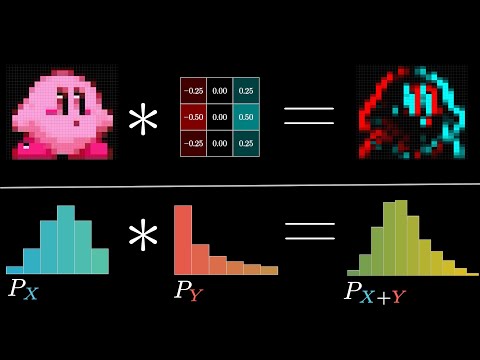
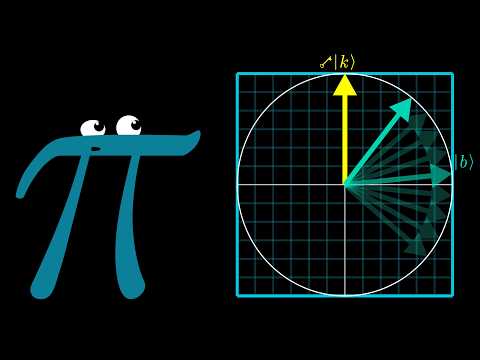
But what is a convolution?

3Blue1Brown
@3blue1brownAbout
My name is Grant Sanderson. Videos here cover a variety of topics in math, or adjacent fields like physics and CS, all with an emphasis on visualizing the core ideas. The goal is to use animation to help elucidate and motivate otherwise tricky topics, and for difficult problems to be made simple with changes in perspective. For more information, other projects, FAQs, and inquiries see the website: https://www.3blue1brown.com
Latest Posts


Video Description
Discrete convolutions, from probability to image processing and FFTs. Video on the continuous case: https://youtu.be/IaSGqQa5O-M Help fund future projects: https://www.patreon.com/3blue1brown Special thanks to these supporters: https://3b1b.co/lessons/convolutions#thanks An equally valuable form of support is to simply share the videos. Other videos I referenced Live lecture on image convolutions for the MIT Julia lab https://youtu.be/8rrHTtUzyZA Lecture on Discrete Fourier Transforms https://youtu.be/g8RkArhtCc4 Reducible video on FFTs https://youtu.be/h7apO7q16V0 Veritasium video on FFTs https://youtu.be/nmgFG7PUHfo A small correction for the integer multiplication algorithm mentioned at the end. A “straightforward” application of FFT results in a runtime of O(N * log(n) log(log(n)) ). That log(log(n)) term is tiny, but it is only recently in 2019, Harvey and van der Hoeven found an algorithm that removed that log(log(n)) term. Another small correction at 17:00. I describe O(N^2) as meaning "the number of operations needed scales with N^2". However, this is technically what Theta(N^2) would mean. O(N^2) would mean that the number of operations needed is at most constant times N^2, in particular, it includes algorithms whose runtimes don't actually have any N^2 term, but which are bounded by it. The distinction doesn't matter in this case, since there is an explicit N^2 term. Thanks to these viewers for their contributions to translations Hebrew: Omer Tuchfeld Italian: Emanuele Vezzoli Vietnamese: lkhphuc -------- These animations are largely made using a custom python library, manim. See the FAQ comments here: https://www.3blue1brown.com/faq#manim https://github.com/3b1b/manim https://github.com/ManimCommunity/manim/ You can find code for specific videos and projects here: https://github.com/3b1b/videos/ Music by Vincent Rubinetti. https://www.vincentrubinetti.com/ Download the music on Bandcamp: https://vincerubinetti.bandcamp.com/album/the-music-of-3blue1brown Stream the music on Spotify: https://open.spotify.com/album/1dVyjwS8FBqXhRunaG5W5u Timestamps 0:00 - Where do convolutions show up? 2:07 - Add two random variables 6:28 - A simple example 7:25 - Moving averages 8:32 - Image processing 13:42 - Measuring runtime 14:40 - Polynomial multiplication 18:10 - Speeding up with FFTs 21:22 - Concluding thoughts ------------------ 3blue1brown is a channel about animating math, in all senses of the word animate. And you know the drill with YouTube, if you want to stay posted on new videos, subscribe: http://3b1b.co/subscribe Various social media stuffs: Website: https://www.3blue1brown.com Twitter: https://twitter.com/3blue1brown Reddit: https://www.reddit.com/r/3blue1brown Instagram: https://www.instagram.com/3blue1brown Patreon: https://patreon.com/3blue1brown Facebook: https://www.facebook.com/3blue1brown








Cabin Build Essentials
AI-recommended products based on this video

Star Wars Owala FreeSip Insulated Stainless Steel Water Bottle with Straw, BPA-Free Sports Water Bottle, Great for Travel, 32 Oz, Darth Vader

Star Wars Owala FreeSip Insulated Stainless Steel Water Bottle with Straw, BPA-Free Sports Water Bottle, Great for Travel, 32 Oz, GroGu
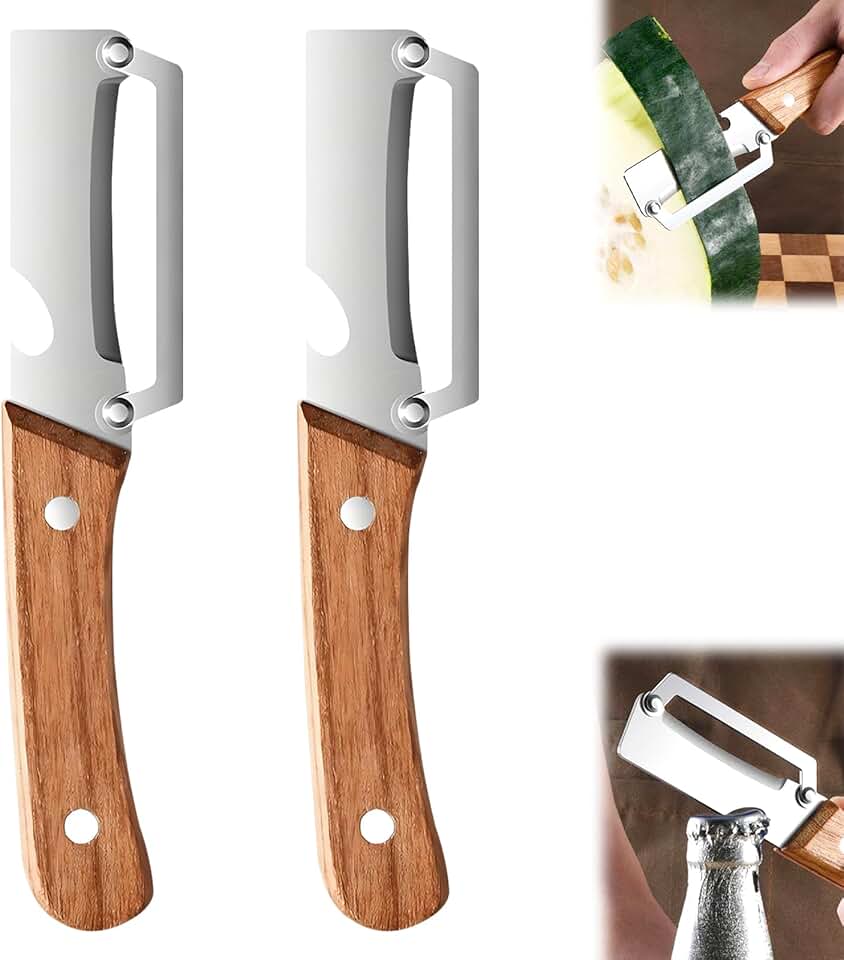
2PC Multi-Functional Vegetable Peeler for Kitchen,Vegetable Peeler Wooden Handle,2-in-1 Stainless Steel Fruit & Vegetable Peelers with Bottle Opener for Potato Pineapple
