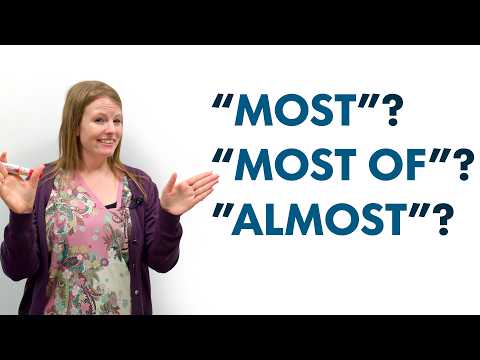
Confusing English Grammar: “MOST”, “MOST OF”, or “ALMOST”?

English with Emma · engVid
@engvidemmaAbout
Hi, my name is Emma, and I'm going to teach you English! Learning a different language can be hard, but it can also be a fun and rewarding experience. I am TESOL-certified and have taught students from various backgrounds, ages, and levels. From immigrants to international students, private lessons to classrooms, my experiences have been varied and have allowed me to gain insight into the challenges that ESL students face. Teaching is one of those great professions that allow you to be forever learning. While I teach students both French and English, they teach me about their cultures, their lives, and other ways to see the world. It is a privilege to teach and I am thankful for all of my students over the years who have shared their stories, interests, and dreams with me.


Video Description
“Most of _________” or “most _________”? It’s easy to make mistakes with words like most, most of, and almost. Watch this English class to clear up the confusion and learn to avoid the common mistakes learners make with these words. You’ll learn when to use “most” and when to use “most of”, and get a deeper understanding of “almost”. After watching, take the quiz to make sure you’ve really understood. https://www.engvid.com/confusing-english-grammar-most-most-of-almost/ More of my beginner grammar lessons: English Grammar: Comparative Adjectives https://youtu.be/HqueToxC4d4 Confusing English Grammar: BY or WITH? https://youtu.be/gix9O_sjEzo In this lesson: 0:00 "Most", "Almost all", "Most of the" 0:37 "Most", "Almost all", "Most of the": Common Mistakes 2:50 "Most": How and when to use it 6:31 "Almost all": How and when to use it 8:09 "Most of the": How and when to use it 12:28 "Most" & "Most of the" Examples TRANSCRIPT: Hello. My name is Emma, and today we will talk about "most" and "almost". Many learners make mistakes with these words, so first of all, I want to show you some mistakes, and I want you to ask yourself, are you making these mistakes? Then, I will teach you how to use "most", "most of", "almost", "all", and "almost" how to use these words correctly. So let's get started by looking at some common mistakes I see. Most of people like movies. Is this sentence correct? So you have "most", "most of", "most of people". This is not correct. You might be surprised. Why is this not correct? If you have "most of", you either need to say "the" or, even better for this example, "most people", just say "most people", and I'll explain the difference between "most of the people" and "most people" in a moment. But yeah, "most people like movies." Oh, better. Okay, what about the next sentence? Do you make a mistake like this? Almost friends live here. Almost friends live here. So this is a mistake. We need more here. We could say "almost all of my friends live here", so that's one possibility. There's different possibilities on how to fix this, but yeah, if you said "almost friends live here", that would be a mistake. It's not grammatically correct. And again, we'll talk about "almost all" in a moment. What about this one? Most cat don't like dogs. I think that's true, but from a grammar perspective, there's a mistake. What's the mistake? Cats. So "most", if you're dealing with countable nouns like "cats", you need it to be plural. So I'll talk a little bit about countable and uncountable nouns with "most" in a moment. So the most important thing for you to know right now is that it's easy to make mistakes with "most" and "almost", so be careful. So let's start with "most". What does "most" mean? Well, "most" is when you're talking about the largest part of something. It's the majority of something. We can even say it's like 50% to 99% of something. So it's not 100%, but it's the majority. So let's look at an example. Most cats like to sleep. So, I want to first point out that most cats like to sleep. What does this mean? Well, it means that the majority of cats like to sleep. There's probably one or two cats who don't. I don't know, I'm not a cat expert, but the majority of cats like to sleep. We could even say maybe 50% to 99% of cats like to sleep. So, we use "most" with nouns. So, not with verbs, we use "most" with nouns, and those nouns can be countable nouns or uncountable nouns. It's okay if you don't know the difference between countable or uncountable. I'll explain the difference between the two. Here's a sentence with a countable noun. "Books". When we have a countable noun, we often have to do something to make it into the plural form. So, I have one book, two books, three books, four books. So, in this case, we add an "s" to the word "book", and we can, you know, we call it countable when we need to add an "s" or make something plural when we're using it. So, some nouns are called countable nouns. So, most books are available online. This means the majority of books, so between 50% to 99% of all books, are available online. We can also use "most" with uncountable nouns. So, for example, "music" is an uncountable noun. We don't add an "s" to it. I don't say one music, two music, three music, four music. No. I just say "music". So, we consider it an uncountable noun, and so I can say most music is available on Spotify. What does this mean? It means the majority of music, or 50% to 99% of music is available on Spotify. […]










Master English Grammar Today
AI-recommended products based on this video
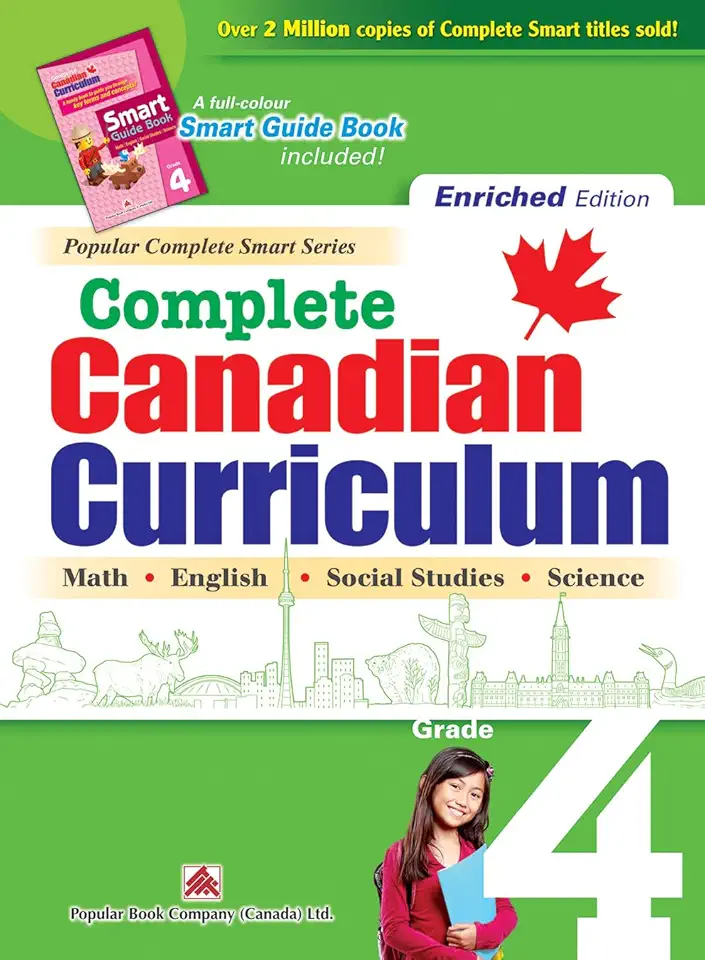
Complete Canadian Curriculum: Grade 4 (Enriched Edition): A Grade 4 integrated workbook covering Math, English, Social Studies, and Science
Complete Canadian Curriculum: Grade 4 (Enriched Edition): A Grade 4 integrated workbook covering Math, English, Social Studies, and Science

Complete Canadian Curriculum 1 (Revised & Updated): A Grade 1 integrated workbook covering Math, English, Social Studies, and Science

Complete Canadian Curriculum 2 (Revised & Updated): A Grade 2 integrated workbook covering Math, English, Social Studies, and Science
