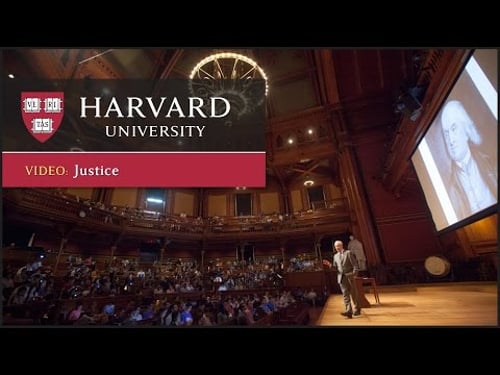
Justice: What's The Right Thing To Do? Episode 02: "PUTTING A PRICE TAG ON LIFE"

Harvard University
@harvardAbout
Welcome to Harvard University! We share videos about life and learning that takes place here on campus and around the world. At Harvard we are devoted to excellence in teaching, learning, and research, and to developing leaders who make a difference globally. Our three main campuses—in Cambridge, Allston, and Boston, Massachusetts—are a home to students and faculty, a hub of research and innovation, and a destination for visitors from all over the world. Established in 1636, Harvard is the oldest institution of higher education in the United States and today consists of the undergraduate Harvard College, 12 graduate and professional Schools, and the Radcliffe Institute for Advanced Study. All content copyrighted by the President and Fellows of Harvard College




Video Description
To register for the 2015 course, visit https://www.edx.org/course/justice-harvardx-er22-1x-0. PART ONE: PUTTING A PRICE TAG ON LIFE Today, companies and governments often use Jeremy Benthams utilitarian logic under the name of cost-benefit analysis. Sandel presents some contemporary cases in which cost-benefit analysis was used to put a dollar value on human life. The cases give rise to several objections to the utilitarian logic of seeking the greatest good for the greatest number. Should we always give more weight to the happiness of a majority, even if the majority is cruel or ignoble? Is it possible to sum up and compare all values using a common measure like money? PART TWO: HOW TO MEASURE PLEASURE Sandel introduces J.S. Mill, a utilitarian philosopher who attempts to defend utilitarianism against the objections raised by critics of the doctrine. Mill argues that seeking the greatest good for the greatest number is compatible with protecting individual rights, and that utilitarianism can make room for a distinction between higher and lower pleasures. Mills idea is that the higher pleasure is always the pleasure preferred by a well-informed majority. Sandel tests this theory by playing video clips from three very different forms of entertainment: Shakespeares Hamlet, the reality show Fear Factor, and The Simpsons. Students debate which experience provides the higher pleasure, and whether Mills defense of utilitarianism is successful.















Ethics Exploration Essentials
AI-recommended products based on this video
