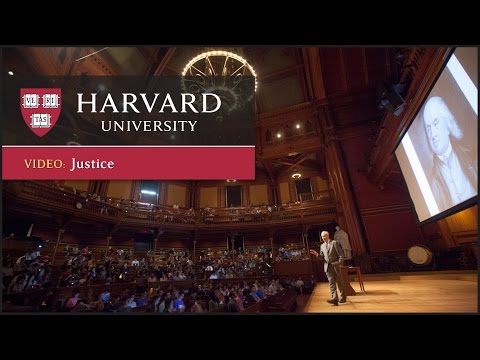
Justice: What's The Right Thing To Do? Episode 08: "WHATS A FAIR START?"

Harvard University
@harvardAbout
Welcome to Harvard University! We share videos about life and learning that takes place here on campus and around the world. At Harvard we are devoted to excellence in teaching, learning, and research, and to developing leaders who make a difference globally. Our three main campuses—in Cambridge, Allston, and Boston, Massachusetts—are a home to students and faculty, a hub of research and innovation, and a destination for visitors from all over the world. Established in 1636, Harvard is the oldest institution of higher education in the United States and today consists of the undergraduate Harvard College, 12 graduate and professional Schools, and the Radcliffe Institute for Advanced Study. All content copyrighted by the President and Fellows of Harvard College



Video Description
To register for the 2015 course, visit https://www.edx.org/course/justice-harvardx-er22-1x-0. ART ONE: WHATS A FAIR START? Is it just to tax the rich to help the poor? John Rawls says we should answer this question by asking what principles you would choose to govern the distribution of income and wealth if you did not know who you were, whether you grew up in privilege or in poverty. Wouldnt you want an equal distribution of wealth, or one that maximally benefits whomever happens to be the least advantaged? After all, that might be you. Rawls argues that even meritocracy—a distributive system that rewards effort—doesnt go far enough in leveling the playing field because those who are naturally gifted will always get ahead. Furthermore, says Rawls, the naturally gifted cant claim much credit because their success often depends on factors as arbitrary as birth order. Sandel makes Rawlss point when he asks the students who were first born in their family to raise their hands. PART TWO: WHAT DO WE DESERVE? Professor Sandel recaps how income, wealth, and opportunities in life should be distributed, according to the three different theories raised so far in class. He summarizes libertarianism, the meritocratic system, and John Rawlss egalitarian theory. Sandel then launches a discussion of the fairness of pay differentials in modern society. He compares the salary of former Supreme Court Justice Sandra Day OConnor ($200,000) with the salary of televisions Judge Judy ($25 million). Sandel asks, is this fair? According to John Rawls, it is not. Rawls argues that an individuals personal success is often a function of morally arbitrary facts—luck, genes, and family circumstances—for which he or she can claim no credit. Those at the bottom are no less worthy simply because they werent born with the talents a particular society rewards, Rawls argues, and the only just way to deal with societys inequalities is for the naturally advantaged to share their wealth with those less fortunate.














No Recommendations Found
No products were found for the selected channel.