NWC Issues in National Security, Lecture 9 "D-Day, 1944"


U.S. Naval War College
View ChannelAbout
The U.S. Naval War College, established in 1884, offers a one-year, resident program that graduates about 600 students a year, and a robust distance program that graduates about 1,000 students a year. Students earn Joint Professional Military Education (JPME) credit and either a diploma or a master's degree in National Security and Strategic Studies. The college's Professional Military Education (PME) programs prepare leaders for the challenges of operational and/or strategic level leadership over the remainder of their careers as decision makers and problem solvers. Through war games, conferences, workshops, and publications from the Center for Naval Warfare Studies, our research arm provides direct curriculum support to our educational programs and focused, task-driven analysis for fleet customers and government agencies across the national security spectrum. Find out more about NWC at www.usnwc.edu, www.facebook.com/NavalWarCollege and http://twitter.com/navalwarcollege.
Latest Posts


Video Description
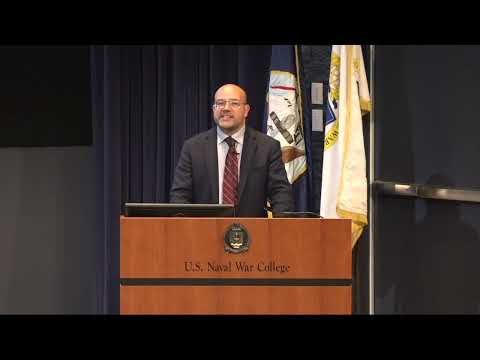
This lecture took place on May 21, 2024. THE 9th LECTURE: OPERATION OVERLORD, the amphibious invasion of northern France at Normandy on 6 June 1944, commonly known as D-Day, represents the Allied opening of the 2nd Front against Nazi Germany in northern Europe. Followed by the Battle of Normandy, the liberation of France, and ultimately the invasion of Germany from the west, it precipitated the eventual collapse of Germany along with the Soviet offensives in the East. Professor Carpenter examines the strategic and operational planning for the invasion as well as highlights many of the most significant events of that seminal event in world history. The lecture focuses on such crucial issues as the decision-making by General Dwight Eisenhower and the SHAEF command staff, the airborne assault on the Pegasus Bridge (Caen Canal), the air campaign preceding the actual landings, and the deception operation known as OPERATION FORTITUDE. Additionally, the lecture looks at the role played by many key personalities on both sides such as General George S. Patton and German Field Marshal Erwin Rommel. About the Speaker: Dr. Stanley D.M. Carpenter Dr. Stanley D.M. Carpenter is Emeritus Professor of Strategy and Policy at the U.S. Naval War College in Newport, Rhode Island. He retired in 2020 after 22 years and served as Strategy and Policy Department Head in the College of Distance Education, where he taught and administered the Strategy and War nonresident programs and served as the Naval War College Command Historian. He holds degrees from Florida State University (Ph.D. in British History), the University of St. Andrews (Scotland)(M.Litt. in Scottish History) and University of North Carolina (A.B. with Honors in History). After thirty years of service, he retired from the US Navy in June 2009 with the rank of Captain having served three commanding officer tours and in several senior staff posts. He researches and publishes extensively on the British Civil Wars, the American Revolution and War of American Independence, American and British military and naval history, military leadership, and the two 20th century world wars. He is also the author of several historical fiction action-adventure novels. Professor Carpenter lectures extensively at public venues and historical associations throughout the Northeast, the Carolinas, and Virginia. Most recently, he served as the Resident Historian onboard Viking Ocean Cruise Line ships in the Mediterranean Sea, Atlantic, and Baltic and is currently the Naval Order of the United States Historian General.
Essential WWII History Books
AI-recommended products based on this video

The Book of Sheen: A Memoir

First Day Jitters (The Jitters Series)

The Road of Bones: The Ashen Series, Book One
