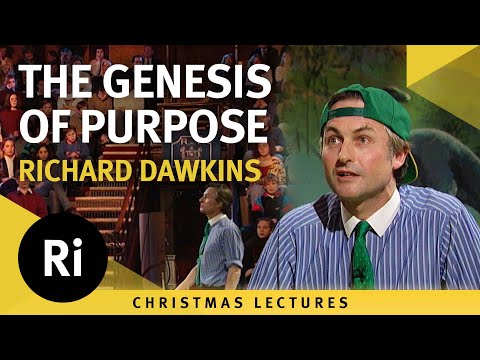
The genesis of purpose - Richard Dawkins 1991 Christmas Lectures 5/5

The Royal Institution
@theroyalinstitutionAbout
Explosive short films, full length talks from the world’s leading scientists and writers, and videos to challenge the way you look at the world. The Royal Institution is a 200 year old independent charity creating opportunities for the public and scientists to explore science together, through events, education, and the CHRISTMAS LECTURES. Consider becoming a YouTube Member: https://www.youtube.com/channel/UCYeF244yNGuFefuFKqxIAXw/join Or support us by donating: https://www.rigb.org/join-and-support/donate-ri We're part of the Amazon Associates programme, if you click on geni.us links in our video descriptions we may earn a commission on purchases. This doesn't cost you anything and the proceeds go towards our charitable work. The Royal Institution of Great Britain is a registered charity, number: 227938.



Video Description
In his final lecture, Richard Dawkins examines the genesis of ‘purpose’ within the universe and relates this to the development of consciousness within the human brain. Watch all the lectures in this series here: https://www.youtube.com/playlist?list=PLbnrZHfNEDZwJw3_jDeusmHuVYDdKRpo9 Watch our newest Christmas lectures here: https://www.youtube.com/playlist?list=PLbnrZHfNEDZyQJZLPMjwEoOLdkFBLU2m1 This lecture was filmed at the Ri on 5 December 1991. This series of lectures was originally an exclusive for our Science Supporters, as part of our project to upload all our archived Christmas Lectures to Youtube. Get early access to the rest of the archive by signing up as a YouTube channel member, and help us bring science to more people: https://www.youtube.com/channel/UCYeF244yNGuFefuFKqxIAXw/join --- Humans have grown up in the universe continually searching for purpose. We once believed that complex organisms adhered to some sort of grand design, similar to the way in which our own tools were created from. We designed and created our own tools for specific purposes. In reality, nature exists without purpose and any meaning we place upon it is created solely within our own brains and these, in turn, are products of evolution, not design. In his final lecture, Richard Dawkins examines the genesis of ‘purpose’ within the universe and relates this to the development of consciousness within the human brain. Dawkins demonstrates that the brain recreates an internal model of our external reality in a similar way to the virtual reality ‘worlds’ created by computers. He examines the limitations of the mind to generate a true representation of our external reality, demonstrating its susceptibility to confusion, error and illusion. He argues that as we begin to move forward and model the universe scientifically we will become less prone to indoctrination, irrationality and superstition. Ultimately Dawkins calls for us to focus our attention on a greater group purpose, in which there is limitless potential as seen in the examples of space exploration and the human genome project. -- About the 1991 CHRISTMAS LECTURES The world-famous evolutionary biologist Richard Dawkins presents the CHRISTMAS LECTURES on "our own growing knowledge of how life grows up in the universe." Just as children grow up to be adults, so too does life gradually evolve on a planet over thousands of generations, to move from “nonliving simplicity” to become “living complexity”. Combining beautiful writing with a range of illuminating demonstrations, the series featured a variety of wildlife, a virtual reality Lecture Theatre, and special guests – including the late Douglas Adams reading an excerpt from The Hitchhiker's Guide to the Galaxy. Find out more about the Ri CHRISTMAS LECTURES here: https://www.rigb.org/christmas-lectures --- We have uploaded Richard Dawkins’ 1991 CHRISTMAS LECTURES to YouTube as part of our commitment to make all past series of the CHRISTMAS LECTURES available to everyone worldwide. But we also want to make it clear that we consider Richard Dawkins’ more recent opinions about members of marginalised communities to be unacceptable. Although we respect everyone's right to form opinions in scientific debate, or in their own lives, if those opinions are built upon discrimination or hostility, we reserve the right not to validate them. Find out more about our commitment to equity, diversity, inclusion and accessibility. https://www.rigb.org/about-us/equity-diversity-inclusion-and-accessibility-ri --- Join this channel to get access to perks: https://www.youtube.com/channel/UCYeF244yNGuFefuFKqxIAXw/join Subscribe for regular science videos: http://bit.ly/RiSubscRibe The Ri is on Twitter: http://twitter.com/ri_science and Facebook: http://www.facebook.com/royalinstitution and TikTok: https://www.tiktok.com/@ri_science Listen to the Ri podcast: https://podcasters.spotify.com/pod/show/ri-science-podcast Donate to the RI and help us bring you more lectures: https://www.rigb.org/support-us/donate-ri Our editorial policy: https://www.rigb.org/editing-ri-talks-and-moderating-comments Subscribe for the latest science videos: http://bit.ly/RiNewsletter Product links on this page may be affiliate links which means it won't cost you any extra but we may earn a small commission if you decide to purchase through the link








Evolutionary Biology Must-Haves
AI-recommended products based on this video
