Energy Can’t Be Created or Destroyed! Why?


Arvin Ash
@arvinashAbout
Complex Questions - Explained Simply, in about 15 minutes. I like to ask and answer BIG questions. We use animations, live videos, simple analogies and narration to explain complex subjects in science, technology, consciousness, and other weighty matters. If you want to understand the true nature of reality, or just have your mind blown once in a while - check us out.
Latest Posts


Video Description
👉 To learn for free on Brilliant, go to https://brilliant.org/arvinash . Get a 20% discount on the annual premium subscription if you subscribe! Your subscription will help us create more videos like this! Thank you so much! TALK TO ARVIN https://www.patreon.com/arvinash FURTHER VIEWING Physics of chemical energy: https://youtu.be/VMqCj_wC0VY Quantum Field Theory: https://youtu.be/eoStndCzFhg CHAPTERS 0:00 Symmetry leads to Conserved quantities 1:40 Three major conservation laws 4:03 What is symmetry in physics? 5:43 Emmy Noether's theorem and genius! 6:29 What does symmetry have to do with Energy conservation? 8:26 How does space symmetry lead to momentum conservation? 9:59 Gauge symmetry lead to charge conservation. How? SUMMARY I discuss Noether's theory. Her brilliant logic is the reason Conservation is bedrock: Energy can’t be created or destroyed—only transformed. When you kick a soccer ball, muscle energy becomes the ball’s kinetic energy plus heat and sound; the total stays the same. Likewise, momentum is conserved in collisions—it’s just passed around. These are examples of fundamental conservation laws. Three VIP laws (in closed systems): Conservation of energy (First Law of Thermodynamics): energy changes form (chemical → kinetic → heat, etc.) but the total is constant. Conservation of momentum (linear and angular): the vector sum of mass×velocity (and total angular momentum) stays fixed; e.g., billiards transfers momentum among balls. Conservation of electric charge: total charge is constant; charge can move between objects (e.g., via electron transfer in chemistry) but can’t be created from nothing. Others exist (e.g., lepton and baryon number, mass–energy equivalence), but energy, momentum, and charge are the broadest, most universal. Why these laws hold: symmetry. In physics, a symmetry means the equations (the rules) are unchanged under a transformation—an invariance. Everyday symmetry (mirror images, rotating a snowflake) illustrates the idea. In nature: Time-translation symmetry: doing the same experiment today or tomorrow gives the same laws. Space-translation symmetry: the same laws apply in New York, Beijing, the Milky Way, or Andromeda. Rotational symmetry: turning a setup doesn’t change the rules. Gauge symmetry: shifting certain “reference choices” (like electric potential’s zero point) doesn’t change physical outcomes. Noether’s Theorem (1918): For every continuous symmetry, there is a conserved quantity. Time-translation symmetry ⇒ energy conservation. If energy could spontaneously appear or vanish, there would be “special moments” when the rules changed—violating time symmetry. Because the rules don’t depend on when you run the experiment, energy must be conserved. Space-translation symmetry ⇒ momentum conservation. If momentum could change for no reason (e.g., a boat starts moving with no push), the rules would depend on where you are—violating spatial symmetry. Thus total momentum stays constant. (By the same logic, rotational symmetry ⇒ angular momentum conservation.) #energyconservation #physics Gauge symmetry ⇒ charge conservation. Choosing a different zero for electric potential (like choosing a different “zero height”) doesn’t change real physics. If charge could pop in or out of existence, changing that reference would alter outcomes—breaking the gauge symmetry. Because gauge symmetry holds, total electric charge is conserved. Intuition/examples used: Energy transforms but totals match (soccer kick, car braking, candles). Momentum transfer shown with billiards and a two-boats-and-basketball scenario (ignoring water friction for simplicity). Gauge symmetry explained with “zero height” vs. “zero electric potential” analogy; shifting the reference shifts numbers, not reality. Big picture: Before Noether, conservation laws were observational rules of thumb; after Noether, they became necessary consequences of symmetry—revealing a deep order behind physical law. (Einstein lauded Noether as an extraordinary creative mathematical genius.) What the video will do: break down the three major conservation laws, connect each to its symmetry, and show how Noether’s insight exposes “why” these rules must hold.
Essential Physics Lab Tools
AI-recommended products based on this video
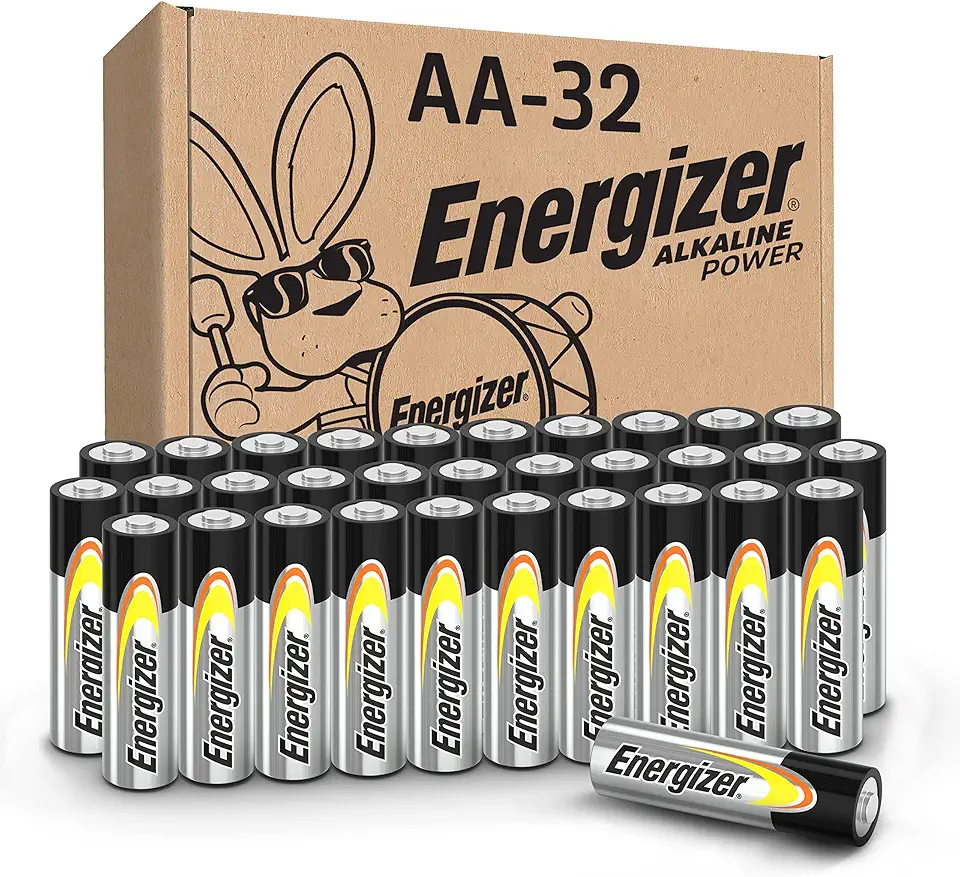
Energizer AA Batteries Alkaline Power, 32 Count Alkaline Double A Battery Pack

Anker Power Bank(PowerCore 10K),Compact Travel-Ready 10,000mAh Battery Pack with PowerIQ Charging Technology,5V/3A High-Speed Charging for iPhone,iPad,and More (USB-C Input and Output(Black),1pack) ClimatePartner certified

VOLTME Portable Charger, Slim 10000mAh 5V/3A Power Bank, USB C in&Out High-Speed Charging Battery Pack, Travel Essentials Dual Output Compatible with iPhone 16 15 14 13 12 Samsung Google iPad etc
