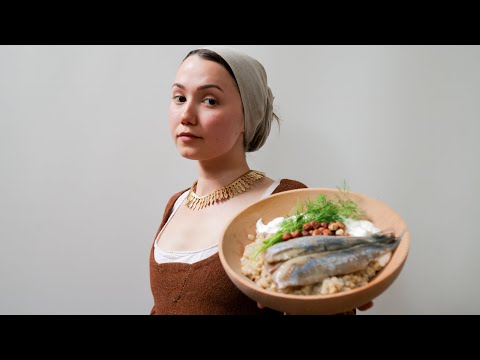
I Ate Only 10th Century Arab (Abbasid) Food for a Week


V. Birchwood
@vbirchwoodAbout
I'm a daily wearer of historical clothing and a Volga Tatar. I’m also passionate about experimental archaeology. I enjoy glimpsing firsthand into what it may have been like for people in the past, applied in a modern context by exploring historical fashion and hand sewing, and how we can interact with the world in a more compassionate, sustainable, and connected way. For business inquiries please contact: [email protected] For my own everyday clothing, I wear Ancient Greek, Medieval, Renaissance, Prehistoric and other eras, as well as incorporating more of my Indigenous (Turkic) dress. All the garments I make for myself are 100% hand-stitched and are slow to construct! I feel this is a wonderful way to connect with the process of sewing and show the durability of hand-sewn garments. This is a welcoming space for all genders, sexualities, ethnicities, and any other marginalised groups. My account is supervised by the Dutch Media Authority.
Latest Posts


Video Description
AD Thanks so much to Hungry Minds for sponsoring this video! To get 10% off "The Book" use code BIRCHWOOD10 at checkout: https://tinyurl.com/bde7pd99 (offer expires May 4th, 2025) In this episode of the historical food week series, I’m adventuring into 10th century Arab food! Credits: Camera operator for sponsorship outdoor scenes: Eva Snijders Research consultant: Sarah Prince, researcher at University of St Andrews All other pre-production, production, and post-production roles done by V. Birchwood 🕯 Support my art on Patreon - https://www.patreon.com/vbirchwood ✨ Leave a donation: https://ko-fi.com/vbirchwood 🪡 Follow me on Instagram - https://www.instagram.com/vasibirchwood/ 📖 Business inquiries - [email protected] Image Sources: https://commons.wikimedia.org/wiki/File:6DSC0007(1).jpg https://commons.wikimedia.org/wiki/File:Murri_recipe_kitab_al-tabikh_ayasofya_3710.png https://commons.wikimedia.org/wiki/File:Tatar_Latin_Janalif_Arabic_1928.png Любослов Езыкин, CC BY-SA 3.0, via Wikimedia Commons https://commons.wikimedia.org/wiki/File:Borongi_bolgarlar_Gaziz_cover.jpg https://lugatism.com/2022/06/22/outer-garments-in-the-abbasid-caliphate-2/#5-_kaftanQuftan_qaftan https://commons.wikimedia.org/wiki/File:Gentile_da_Fabriano_-_Adorazione_dei_Magi_-_Google_Art_ProjectFXD.jpg https://commons.wikimedia.org/wiki/File:A_Greek_woman,_by_Lawrence_Alma_Tadema.jpg https://commons.wikimedia.org/wiki/File:Red-figure_phiale_woman_dancing_with_crotoa_(Boston_MFA_97.371),_sharpened.jpg https://commons.wikimedia.org/wiki/File:%CE%98%CE%B5%CF%83%CF%83%CE%B1%CE%BB%CE%BF%CE%BD%CE%AF%CE%BA%CE%B7_-_%CE%91%CF%81%CF%87%CE%B1%CE%B9%CE%BF%CE%BB%CE%BF%CE%B3%CE%B9%CE%BA%CF%8C_%CE%9C%CE%BF%CF%85%CF%83%CE%B5%CE%AF%CE%BF_1141.jpg Phyrexian, CC BY-SA 4.0, via Wikimedia Commons https://commons.wikimedia.org/wiki/File:L%27Etoile_-_Le_Rubis_-_Revue_des_Modes_et_de_L%27Industrie_de_Paris_-_Costumes_de_la_Maison_Delphine_Baron_-_1862.jpg https://commons.wikimedia.org/wiki/File:Print,_Plate_No._153_in_Fashion_Review_in_the_Family_Gazette_(Revue_de_la_Mode,_Gazette_de_la_Famille),_1874_(CH_18530117).jpg https://commons.wikimedia.org/wiki/File:Mason_and_Hamlin_Organ_and_Piano_Co._(3093729922).jpg https://commons.wikimedia.org/wiki/File:Dr._Grosvenor%27s_Liver_Aid_(3093697002).jpg https://commons.wikimedia.org/wiki/File:Lazell,_Dalley_and_Co._(3092731585).jpg Further Reading: https://coquinaria.nl/en/murri/ Nawal Nasrallah (translator and editor), 2007 "Annals of the Caliphs' kitchens: Ibn Sayyār al-Warrāq's tenth-century Baghdadi cookbook." Islamic history and civilization (2007). Rodinson, Maxime. “Studies in Arabic Manuscripts Relating to Cookery.” Medieval Arab Cookery. Trans. Barbara Inskip. Blackawton: Prospect Books, 2001. 91–163. Rodinson, M.“Maamåniyya East and West.” Trans. Barbara Inskip. Medieval Arab Cookery. Blackawton: Prospect Books, 2001. 183–97. Rodinson, M. “Romanía and Other Arabic Words in Italian.”Medieval Arab Cookery. Trans. Barbara Inskip. Blackawton: Prospect Books, 2001. 165–82. Rodinson, M. “Venice, the Spice Trade and Eastern Influences on European Cooking.” Medieval Arab Cookery. Trans. Paul James. Blackawton: Prospect Books, 2001. 201–15. Peterson, Toby. “The Arab Influence on Western European Cooking” Journal of Medieval History 6 (1980): 317–40. Wilson, C. Anne. “The Saracen Connection: Arab Cuisine and the Medieval West.” Petits Propos Culinaires. 2 parts. 7 (March 1981): 13–22; 8 (June 1981): 19–28. Sancisi-Weerdenburg, Heleen. “Persian Food Stereotypes and Political Identity.” Food in Antiquity. Exeter: University of Exeter Press, 1995. 286–302. Bober, Phyllis Pray. Art, Culture, and Cuisine: Ancient and Medieval Gastronomy. Chicago: University of Chicago Press, 1999. Bottéro, Jean. “The Culinary Tablets at Yale.” Journal of the American Oriental Society 107. 1 (1987): 11–19 Bottero, Jean. Mesopotamian Culinary Texts. Winona Lake, Indiana: Eisenbrauns, 1995. Bottero, Jean.“The most Ancient Recipes of All.” Patterns of Everyday Life. Ed. David Waines. Hampshire: Ashgate, 2002. 239–46. Bottero, Jean. The Oldest Cuisine in the World: Cooking in Mesopotamia. Chicago: Chicago University Press, 2004. Brabant, Rosa Kuhne. “Al-Rāzī on When and How to Eat Fruit.” Patterns of Everyday Life. Ed. David Waines. Hampshire: Ashgate, 2002. 317–27. https://plantscience.psu.edu/research/projects/grains/heritage-grains/einkorn https://www.nationalgeographic.com/science/article/news-otzi-iceman-food-DNA-diet-meat-fat https://www.learntatar.com/culture/history/the-history-of-tatars-i-the-volga-bulgaria
You May Also Like




Ancient Food Experience Today
AI-recommended products based on this video

Tim Hortons 100% Arabica Original Blend, Medium Roast, Ground Coffee, 875g

Glass Oil Sprayer for Cooking, 180ml Olive Oil Sprayer Bottle with Brush, Olive Oil Spray Mister, Kitchen Gadgets Accessories for Air Fryer, Canola Oil Spritzer (GREY)