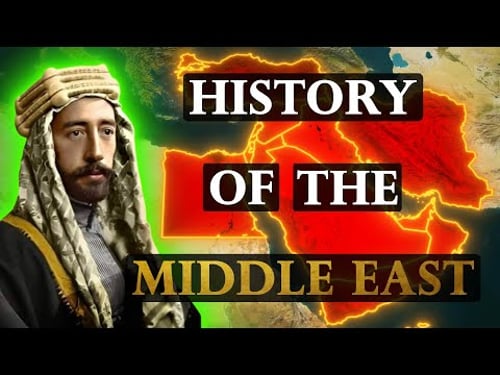
The Entire History of the Middle East

This Is History
@this_is_historyAbout
History documentaries.
Latest Posts

Video Description
#middleeast #history #documentary CHECK OUT OUR MAP STORE HERE: https://www.redbubble.com/people/MapStory/shop WATCH THIS AND ALL OUR VIDEOS OVER ON SPOTIFY: https://open.spotify.com/show/4ONNqWZ8qsl6DIyIp0uR8s?si=a444627f2aa343d7 WATCH THIS AND ALL OUR VIDEOS COMPLETELY AD-FREE OVER ON OUR SUBSTACK: https://thisishistory.substack.com/?r=2zq5ao&utm_campaign=pub-share-checklist The Middle East was one of the cradles of civilization: after the Neolithic Revolution and the adoption of agriculture, many of the world's oldest cultures and civilizations were created there. The Sumerians, around the 5th millennium BC, were among the first to develop a civilization. By 3150 BC, Egyptian civilization unified under its first pharaoh. Mesopotamia hosted powerful empires, notably Assyria which lasted for 1,500 years. For centuries after the 7th century BC, the region was dominated by Persian powers like the Achaemenid Empire. In the 1st century BC, the Roman Republic conquered most of the region, and its successor, the Roman Empire, that ruled from the 6th to 15th centuries AD referred to as the Byzantine Empire, grew significantly more. Roman pagan religions were replaced by Christianity in the 4th century AD. From the 3rd to 7th centuries, Rome ruled alongside the Sasanian Empire. From the 7th century, Islam spread rapidly, expanding Arab identity in the region. The Seljuk dynasty displaced Arab dominance in the 11th century, followed by the Mongol Empire in the 13th century. In the 15th century, the Ottoman Empire invaded most of Anatolia, and dissolved the Byzantine Empire by capturing Constantinople in 1453. The Ottomans and the Safavid dynasty were rivals from the early 16th century. By 1700, the Ottomans were pushed out of Hungary. The British Empire gained control over the Persian Gulf in the 19th century, while French colonial empire extended into Lebanon and Syria. Regional rulers sought modernization to match European powers. A key moment came with the discovery of oil, first in Persia (1908), then in Saudi Arabia (1938), and other Gulf states, leading to increased Western interest in the region. In the 1920s to 1940s, Syria and Egypt pursued independence, in 1948 Israel became an independent Jewish state. The British, French, and Soviets withdrew from much of the region during and after World War II. In 1947 the United Nations plan to partition Palestine was voted in favor for a Jewish homeland. Amid Cold War tensions, pan-Arabism emerged in the region. The end of European colonial control, the establishment of Israel, and the rise of the petroleum industry shaped the modern Middle East. Despite economic growth, many countries faced challenges like political restrictions, corruption, cronyism and overreliance on oil. The wealthiest per capita are the small, oil-rich Gulf states, namely Qatar, Kuwait, Bahrain, and the United Arab Emirates. Several key events shaped the modern Middle East, such as the 1967 Six-Day War, the 1973 OPEC oil embargo in response to US support for Israel in the Yom Kippur War, and the rise of Salafism/Wahhabism in Saudi Arabia that led to rise of Islamism. Additionally, the Iranian Revolution contributed to a significant Islamic revival. The dissolution of the Soviet Union in 1991 ended the Cold War, and regional conflict was soon made part of the War on Terror. In the early 2010s, the Arab Spring triggered major protests and revolutions in the region. As of today, the Middle East remains a complex and contested geopolitical landscape. While some states—particularly in the Gulf—have seen rapid modernisation and economic growth through oil wealth, tourism, and investment, others remain plagued by authoritarianism, corruption, and conflict. Deep-rooted sectarian, ethnic, and political rivalries persist, and the legacy of foreign intervention continues to shape popular attitudes and regional alignments. The region remains at a crossroads: rich in potential, yet burdened by a history of division, intervention, and unfulfilled aspirations.
You May Also Like





Ancient History Buff's Kit
AI-recommended products based on this video

We Who Will Die: An Epic Romantasy of Forbidden Love, Deadly Secrets, and Vampires in a High-Stakes Arena, Discover a Vividly Reimagined Ancient Rome (Empire of Blood Book 1)

Magnetic Blocks, Magnetic Building Blocks, Magnet Tiles Toddler Toys STEM Sensory Montessori Toys for 3+ Year Old Boys & Girls, Kids Toys Gift Ideal for Toddler with Autism

32pcs Magnetic Blocks Building Cubes for Kids, Classroom Must Haves Creative Learning Kids Gifts, Preschool Montessori Sensory Autism Toddler Magnet Toys for Boys and Girls Ages 3 4 5 6

Upgraded Magnetic Tiles Toys for 3 4 5 6 7 8+ Year Old Toddlers Boys Girls, Magnetic Building Blocks Educational STEM Toys Gifts for Age 3-6 4-5 4-8 Kids Christmas Birthday

LEGO DUPLO Town Truck & Tracked Excavator Construction Toys - Toddler Sensory & Learning Toys, Boys & Girls, Ages 2+ - Building Blocks to Develop Fine Motor Skills - Gift Idea for Birthdays - 10931

Toddler Kitchen Tower, Learning Standing Tower, 4-in-1 Kitchen Black Wooden Stool Helper with Chalkboard Montessori and Waldorf Helper for Kids in Kitchen

Budget Binder Book Set- 17.6cm X 23.5cm Portable 100 Envelope Challenge Binder| Multifunctional Savings Challenges Book Set| Envelope Challenge Binder Set for Saving Accessories and Persoon