The spelled-out intro to language modeling: building makemore


Andrej Karpathy
@andrejkarpathyAbout
Latest Posts


Video Description
We implement a bigram character-level language model, which we will further complexify in followup videos into a modern Transformer language model, like GPT. In this video, the focus is on (1) introducing torch.Tensor and its subtleties and use in efficiently evaluating neural networks and (2) the overall framework of language modeling that includes model training, sampling, and the evaluation of a loss (e.g. the negative log likelihood for classification). Links: - makemore on github: https://github.com/karpathy/makemore - jupyter notebook I built in this video: https://github.com/karpathy/nn-zero-to-hero/blob/master/lectures/makemore/makemore_part1_bigrams.ipynb - my website: https://karpathy.ai - my twitter: https://twitter.com/karpathy - (new) Neural Networks: Zero to Hero series Discord channel: https://discord.gg/3zy8kqD9Cp , for people who'd like to chat more and go beyond youtube comments Useful links for practice: - Python + Numpy tutorial from CS231n https://cs231n.github.io/python-numpy-tutorial/ . We use torch.tensor instead of numpy.array in this video. Their design (e.g. broadcasting, data types, etc.) is so similar that practicing one is basically practicing the other, just be careful with some of the APIs - how various functions are named, what arguments they take, etc. - these details can vary. - PyTorch tutorial on Tensor https://pytorch.org/tutorials/beginner/basics/tensorqs_tutorial.html - Another PyTorch intro to Tensor https://pytorch.org/tutorials/beginner/nlp/pytorch_tutorial.html Exercises: E01: train a trigram language model, i.e. take two characters as an input to predict the 3rd one. Feel free to use either counting or a neural net. Evaluate the loss; Did it improve over a bigram model? E02: split up the dataset randomly into 80% train set, 10% dev set, 10% test set. Train the bigram and trigram models only on the training set. Evaluate them on dev and test splits. What can you see? E03: use the dev set to tune the strength of smoothing (or regularization) for the trigram model - i.e. try many possibilities and see which one works best based on the dev set loss. What patterns can you see in the train and dev set loss as you tune this strength? Take the best setting of the smoothing and evaluate on the test set once and at the end. How good of a loss do you achieve? E04: we saw that our 1-hot vectors merely select a row of W, so producing these vectors explicitly feels wasteful. Can you delete our use of F.one_hot in favor of simply indexing into rows of W? E05: look up and use F.cross_entropy instead. You should achieve the same result. Can you think of why we'd prefer to use F.cross_entropy instead? E06: meta-exercise! Think of a fun/interesting exercise and complete it. Chapters: 00:00:00 intro 00:03:03 reading and exploring the dataset 00:06:24 exploring the bigrams in the dataset 00:09:24 counting bigrams in a python dictionary 00:12:45 counting bigrams in a 2D torch tensor ("training the model") 00:18:19 visualizing the bigram tensor 00:20:54 deleting spurious (S) and (E) tokens in favor of a single . token 00:24:02 sampling from the model 00:36:17 efficiency! vectorized normalization of the rows, tensor broadcasting 00:50:14 loss function (the negative log likelihood of the data under our model) 01:00:50 model smoothing with fake counts 01:02:57 PART 2: the neural network approach: intro 01:05:26 creating the bigram dataset for the neural net 01:10:01 feeding integers into neural nets? one-hot encodings 01:13:53 the "neural net": one linear layer of neurons implemented with matrix multiplication 01:18:46 transforming neural net outputs into probabilities: the softmax 01:26:17 summary, preview to next steps, reference to micrograd 01:35:49 vectorized loss 01:38:36 backward and update, in PyTorch 01:42:55 putting everything together 01:47:49 note 1: one-hot encoding really just selects a row of the next Linear layer's weight matrix 01:50:18 note 2: model smoothing as regularization loss 01:54:31 sampling from the neural net 01:56:16 conclusion
You May Also Like
![[1hr Talk] Intro to Large Language Models](https://imgz.pc97.com/?width=500&fit=cover&image=https://i.ytimg.com/vi/zjkBMFhNj_g/hqdefault.jpg)









Boost Your Data Science Toolkit
AI-recommended products based on this video

UCANUUP 130W Tip 4.5mm Compatible with Dell XPS 15 7590 9530 9550 9560 9570 9575 Inspiron 7348 Precision M3800 5510 5520 5530 06TTY6 AC Adapter Power Replacement Supply Cord

tomtoc 360° Protective Laptop Sleeve for 15-inch MacBook Air M4/A3241 2025, M3/A3114 2024, M2/A2941 2023, 15-inch MacBook Pro A1990 A1707, Dell XPS 15 Plus Laptop, Water-Resistant Computer Case Bag Global Recycled Standard

MOSISO 360 Protective Laptop Bag 15 inch, 15 inch Computer Shoulder Bag Compatible with MacBook Air 15 M4 M3 M2 2025-2023, Dell XPS 15, Side Open Messenger Case &4 Zipper Pockets&Handle, Black Global Recycled Standard

UGREEN 130W Car Charger USB C Fast Charger PD3.0 QC4.0 PPS Fast Charging Car Adapter with 100W USB C Cable Compatible with Dell XPS, MacBook, iPhone 16 15 14 Pro Max, Galaxy S25 S24 Ultra, iPad Pro

AocBook 15.6'' FHD Laptop, Intel N95, Nvidia GTX 1060 4GB, 32GB DDR4 RAM, M.2 SSD, Sleek Notebook with Type-C, HDMI, RJ45 Ethernet, Backlit Keyboard, Fingerprint (32GB DDR4 | 1TB SSD)

acer Nitro 50 N50-620-UA91 Gaming Desktop | 11th Gen Intel Core i5-11400F 6-Core Processor | NVIDIA GeForce GTX 1650 | 8GB DDR4 | 512GB NVMe M.2 SSD | Intel Wi-Fi 6 AX201 | Keyboard and Mouse

Buffalo LinkStation 210 4TB 1-Bay NAS Network Attached Storage with HDD Hard Drives Included NAS Storage That Works as Home Cloud or Network Storage Device for Home

Spy Camera, Hidden Camera 4K Ultra HD with 4H Battery Life, SD Card & Cloud Storage, Motion Detection Alarm, Real-Time App Alerts, 2.4G WiFi & Night Vision for Home/Office Security
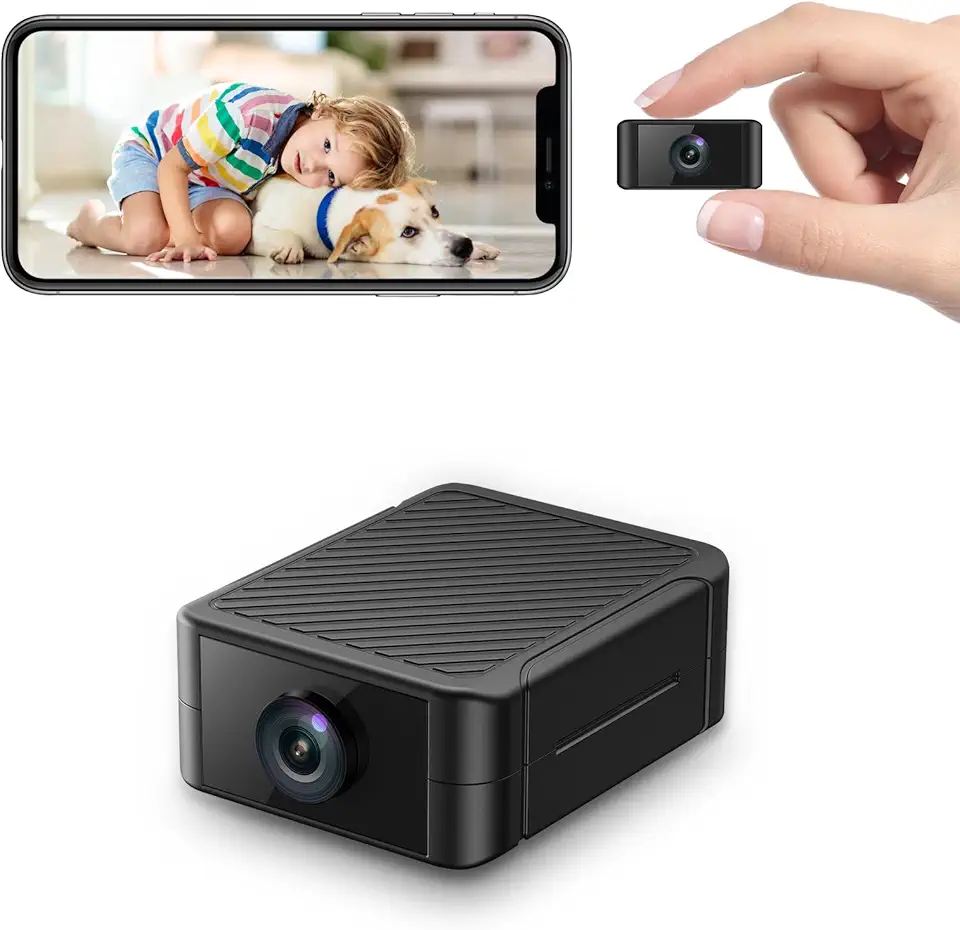
Spy Camera, Hidden Camera 4K Ultra HD with 4H Battery Life, SD Card & Cloud Storage, Motion Detection Alarm, Real-Time App Alerts, 2.4G WiFi & Night Vision for Home/Office Security

VASAGLE Tall Bathroom Cabinet with Lights, Slim Bathroom Storage Cabinet, Freestanding Narrow Cabinet with Adjustable Shelves, for Small Spaces, Modern, 40 cm Wide, Cloud White UBBC766W02

Google Pixel Buds Pro 2 - Noise Canceling Earbuds - Up to 31 Hour Battery Life with Charging Case - Bluetooth Headphones - Compatible with Android - Hazel

Deeyaple USB C to Aux, 4FT/1.2M, Type C to 3.5mm Audio Cable Headphone Jack Cable for Car Mobile Phone, iPhone 16 15, iPad Pro, Samsung Galaxy S24 S23 S2010, Google Pixel,Oneplus Grey (1)
