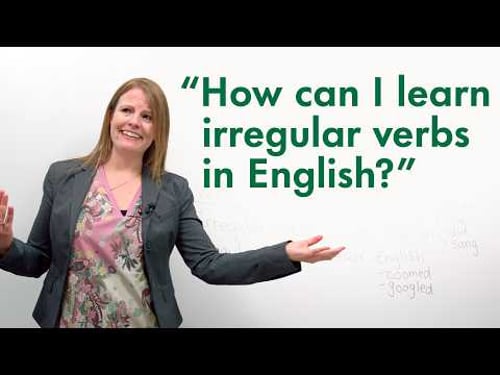
How to Learn Past Tense IRREGULAR VERBS... the EASY Way!

English with Emma · engVid
@engvidemmaAbout
Hi, my name is Emma, and I'm going to teach you English! Learning a different language can be hard, but it can also be a fun and rewarding experience. I am TESOL-certified and have taught students from various backgrounds, ages, and levels. From immigrants to international students, private lessons to classrooms, my experiences have been varied and have allowed me to gain insight into the challenges that ESL students face. Teaching is one of those great professions that allow you to be forever learning. While I teach students both French and English, they teach me about their cultures, their lives, and other ways to see the world. It is a privilege to teach and I am thankful for all of my students over the years who have shared their stories, interests, and dreams with me.


Video Description
What is an irregular verb in English? It’s a verb that does not end with “-ed” in the past tense. So, we’re talking about verbs like “ate” or “spoke”. These verbs can be very challenging for English learners. It feels like it’s impossible to learn all of them. In this class, I’ll give you my tips for learning irregular verbs. With a small amount of effort, you can master a large portion of the irregular verbs in English. I'll even show you how you can use ChatGPT to make your learning more active. Watch now and start learning irregular verbs in English with confidence! Don’t forget to take the quiz to practice what you’ve learned. https://www.engvid.com/ Next, watch more of my grammar videos: Learn the Most Common ADVERBS in English https://youtu.be/-nIEc4hxqzk English Grammar: How to use "TO" before an "-ING" verb https://youtu.be/0nDFTCJ7jXA In this lesson: 0:00 Learn Irregular Verbs in English 0:15 What is an irregular past tense verb? 3:20 Learn the 10 most common irregular verbs 6:21 The next 10 most common irregular verbs 7:38 Learn the 4 irregular verb patterns! 8:54 Group 1: Vowel Change 12:22 Group 2: Same Form 13:50 Group 3: -en 14:55 Group 4: Unique 15:45 How to practice irregular verbs TRANSCRIPT: Hello. My name is Emma, and today I am going to teach you how to learn irregular past tense verbs. So, I'm going to teach you some easy methods and tips on how to do this. So, first of all, let's talk about what is an irregular past tense verb. Well, I have here two sentences. The first one says "yesterday I wanted to travel". The second sentence says "yesterday I ate the cake". So, in English, when we're talking about the past tense, so something that happened in the past, like "yesterday", "last month", "last year", we need to do something to the verb. So, most verbs follow this "ed" rule, which you might have learned before. "Learned" is an example of this. For many verbs, we add "ed" to the end to make it a past tense verb. But not all verbs follow this, unfortunately, in English. We have these things called irregular verbs. Irregular verbs are verbs like "ate". We don't say "he ated the cake". That would make things really easy, but unfortunately, English is not the easiest language. Those of you learning probably know this. So, you might think, "Why do we sometimes use 'ed' and why do we sometimes have these verbs that are irregular, like 'ate'?" Well, the reason... So, we have this "Why? Why, Emma?" and we have this sad face. The reason English is so complicated, it's not because I created the language; it's because the old parts of English have these irregular verbs. So, any verb that's extremely old from the beginning or the early days of English, they have... They're the irregular verbs. So, for example, "spoke" is the irregular verb of "speak". We already talked about "ate", which is the irregular verb of "eat"; "did" is the irregular past tense verb of "do"; or "sang", that's the irregular past tense of "sing". So, all of these verbs are very old. Now, the newer verbs in English are the ones that are the easy ones because you just add "ed". So, for example, "decided", "visited", "wanted", these are all later verbs in English. And even when in English we make new verbs, we usually use the "ed". So, for example, "googled", "I googled my name." Or even "zoomed", a lot of people use "zoom". We've turned it into a verb, "zoomed". "Yesterday, I zoomed my sister." So, in this video, we're not going to focus on these easy, regular verbs; we're going to focus on the hard, irregular verbs, and I'm going to teach you how to learn these verbs. So, let's get started. Alright, so, the first part of my method for learning irregular past tense verbs is to learn the most common ones first. So, here are the most common. These are the most commonly used in English. There's many irregular verbs. I recommend you start with the most commonly used ones first and memorize them. You might already know a lot of these already. So, for example, the verb "be", here's the present tense, which might be "I am", "he is", "they are". If we're talking about the past, we don't use "ed" here; it's irregular. We can use "was" or "were". "He was", "they were". Most of you probably know the "be" verb. The next one after that is "have". "Have" in the present form becomes "has" or "have", so "I have", "she has", it depends on the subject. If we're talking about "he", "they", "we", "you", it might change the verb, so we have "have" or "has". Well, what's the past tense of this verb? It's "had". So, if I'm talking about last year, last year I had a lot of fun, I could say. So, this is an irregular verb; it's irregular because it does not end in "ed". It's following a different set of rules; it's an irregular past tense verb. […]











Master English Faster
AI-recommended products based on this video

Apple 2025 MacBook Air 13-inch Laptop with M4 chip: Built for Apple Intelligence, 16GB Unified Memory, 256GB SSD Storage, Touch ID; Sky Blue - English Keyboard