Shielded vs Unshielded Ethernet Cables: Which Do You Need?

NetWork From Home
@network-from-homeAbout
At NetWork from Home, my goal is to help everyone get the most out of their home internet connections. I will break down the technical concepts surrounding home networks so you are comfortable making decisions that maximize your internet connection and allow you to safely access the internet.
Latest Posts




Video Description
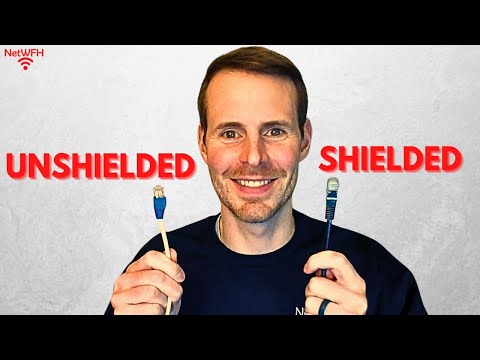
In this video, I detail the difference between shielded and unshielded ethernet cables. I also discuss the scenarios where you should be using each type of cable. For more content on similar topics, check out my YouTube channel: https://www.youtube.com/channel/UCs-hXDMwqs1Ri9Yh9QRgaqQ If you would like to read about other ways to improve your home network, check out my blog: https://www.network-from-home.com 0:52 The difference between shielded and unshielded ethernet cables 3:04 Why shielded and unshielded cables exist 5:39 When to use shielded and unshielded cables This post contains affiliate links. This means I may earn a commission should you choose to sign up for a program or make a purchase using my link. If you need unshielded ethernet cables for your home network, you can try out these Cat6 cables: https://amzn.to/3EMcyYW For a shielded ethernet cable, here is a cable I recommend (these also provide Power over Ethernet): https://amzn.to/3EQP98L What is the difference between shielded and unshielded ethernet cables? The main difference between shielded and unshielded ethernet cables is their ability to reduce (or eliminate) the effects of electromagnetic interference (EMI) on the cable. If ethernet cables are exposed to EMI while transferring data, it can disrupt the connection and greatly reduce the performance of the cable. Shielded ethernet cables were created to prevent just that. Shielded ethernet cables have a foil layer that wraps around the 4 pairs of twisted copper wires inside an ethernet cable. In addition, there’s a wire that runs along the length of the ethernet cable on the inside of the foil. This wire is called a drain wire. The purpose of the foil and drain wire is to ground any EMI in the environment around the ethernet cable. This effectively reduces the impact of EMI coming from the area around the ethernet cable. Unshielded ethernet cables do not have this protection, and as a result, they shouldn’t be used in environments with a lot of EMI. The good news here is that most homes and offices do not normally have many sources of EMI, so in most cases, unshielded ethernet cables will work just fine. Conversely, shielded ethernet cables should be used in environments with heavy machinery, electrical wires providing alternating current, microwaves, and electric motors. Conclusion If you have any questions about the difference between shielded and unshielded ethernet cables or when to use them, please leave a comment below.
You May Also Like









Upgrade Your Home Network Today
AI-recommended products based on this video

Laplink PCmover Ultimate 11 - Migration of your Applications, Files and Settings from an Old PC to a New PC - Data Transfer Software - With Optional High Speed Ethernet Cable - 1 License

DCNETWORK iPhone 4s Cable USB Sync and Charging Cable for iPhone 4 4s 3G 3GS iPad 1 2 3 iPod Touch Nano 30 Pin Charger Cord Dock Adapter Data 3.3 Feet (White)

TP-Link 5 Port Gigabit Ethernet Network Switch (TL-SG1005D) - Plug and Play, Desktop or Wall Mount, Plastic Case, Ethernet Splitter, Fanless, Traffic Optimization, Unmanaged (TL-SG1005D)

TP-Link USB to Ethernet Adapter (UE306) - Foldable USB 3.0 to Gigabit Ethernet LAN Laptop Network Adapter, Supports Nintendo Switch, Windows, Linux, Apple MacBook OS 10.11- OS 12, Surface
Laplink PCmover Ultimate 11 - Migration of your Applications, Files and Settings from an Old PC to a New PC - Data Transfer Software - With Optional High Speed Ethernet Cable - 1 License